Wednesday, February 29, 2012

Sunday of Orthodoxy Vespers 2012


TRIUMPH OF ORTHODOXY: 4 MARCH 2012

Hieromartyr Konon of Isauria; Martyrs Archelaos and his 152 companions in Egypt; New-martyr John the Bulgarian; Repose of Nikolai of Zhicha and Ochrid

SUNDAY EVENING VESPERS SERVICE


Priest:       Blessed is our God, always now and ever and unto ages of ages.
People:      Amen.

Come, let us worship and fall down before God our King.
Come, let us worship and fall down before Christ, our King and our God.
Come, let us worship and fall down before the Very Christ, our King and our God.

PSALM 103
Bless the Lord, O my soul.  O Lord my God, Thou art very great!  Thou art clothed with honor and majesty, Who coverest Thyself with light as with a garment, Who hast stretched out the heavens like a tent, Who hast laid the beams of Thy chambers in the waters, Who makest the clouds Thy chariot, Who ridest upon the wings of the wind, Who makest the winds Thy messengers, fire and flame Thy ministers.  Thou didst set the earth on its foundations, so that it should not be shaken. Thou didst cover it with the deep as with a garment; the waters stood above the mountains.  At Thy rebuke they fled; at the sound of Thy thunder they took to flight.  The mountains rose, the valleys sank down to the place which Thou didst appoint for them. Thou didst set a bound that they should not pass, so that they might not again cover the earth.  Thou makest springs gush forth in the valleys; they flow between the hills.  They give drink to every beast of the field; the wild asses quench their thirst. By them the birds of the air have their habitation; they sing among the branches.  From Thy lofty abode Thou waterest the mountains; the earth is satisfied with the fruit of Thy work.  Thou dost cause the grass to grow for the cattle, and plants for man to cultivate, that he may bring forth food from the earth, and wine to gladden the heart of man, and oil to make his face shine, and bread which strengthens man’s heart.
The trees of the Lord are watered abundantly, the cedars of Lebanon which He planted.  In them the birds build their nests; the stork has her home in the trees.  The high mountains are a refuge for the wild goats; the rocks are a refuge for the badgers.  Thou hast appointed the moon to mark the seasons; the sun knows its time for setting. Thou makest darkness, and it is night, when all the beasts of the forest creep forth.  The young lions roar for their prey, seeking their food from God.  When the sun rises, they get them away and lie down in their dens.  Man goes forth to his work and to his labor until the evening.  O Lord, how manifold are Thy works, in Wisdom hast Thou made them all.  The earth is full of Thy creatures.  Yonder is the sea, great and wide, which teems with things innumerable, living things both small and great.  There go the ships, and Leviathan, which Thou didst form to sport in it.  These all look to Thee, to give them their food in due season.  When Thou givest them, they gather it up; when Thou openest Thy hand, they are filled with good things.  When Thou hidest Thy face, they are dismayed; when Thou takest away their breath, they die and return to their dust.  When Thou sendest forth Thy spirit, they are created: and Thou renewest the face of the ground.  May the glory of the Lord endure for ever!  May the Lord rejoice in His works, who looks on the earth and it trembles, who touches the mountains and they smoke!  I will sing to the Lord as long as I live; I will sing praise to my God while I have being.  May my meditation be pleasing to Him, for I rejoice in the Lord!  Let sinners be consumed from of the earth, and let the wicked be no more.  Bless the Lord, O my soul!  Praise the Lord!

The sun knows its time for setting.  Thou makest darkness, and it is night.  O Lord, how manifold are Thy works! In Wisdom hast Thou made them all.
Glory to the Father, and to the Son and to the Holy Spirit,
Both now and ever and unto ages of ages. Amen.
Alleluia, Alleluia, Alleluia, glory to Thee, O God. (3 times)
O our God and our Hope, glory to Thee.

THE GREAT LITANY
Priest:       In peace, let us pray to the Lord.
Choir:        Lord, have mercy. (Repeated after each petition)
Priest:       For the peace from above, and for the salvation of our souls, let us pray to the Lord.
Priest:       For the peace of the whole world, the good estate of the holy churches of God, and for the union of all men, let us pray to the Lord.
Priest:       For this holy house, and for those who with faith, reverence, and fear of God enter therein, let us pray to the Lord.
Priest:       For our Metropolitans (NN.) for the venerable priesthood, the diaconate in Christ, for all the clergy and the people, let us pray to the Lord.
Priest:       For the President of the United States and all civil authorities, and for our armed forces and those in defense of peace and freedom everywhere, let us pray to the Lord.
Priest:       For this city, and for every city and land, and for the faithful who dwell therein, let us pray to the Lord.
Priest:       For healthful seasons, for the abundance of the fruits of the earth, and for peaceful times, let us pray to the Lord.
Priest:       For travelers by sea, by land, and by air; for the sick and suffering; for captives and for their salvation, let us pray to the Lord.
Priest:       For our deliverance from all tribulation, wrath, danger and necessity, let us pray to the Lord.
Priest:       Help us; save us; and have mercy upon us; and keep us, O God, by Thy grace.
Priest:       Calling to remembrance our all-holy, immaculate, most blessed and glorious Lady Theotokos and Ever-Virgin Mary; with all the saints, let us commend ourselves and each other, and all our life unto Christ our God.
Choir:        To Thee, O Lord.
Priest:       For unto Thee are due all glory, honor and worship: To the Father, and to the Son, and to the Holy Spirit; now and ever, and unto ages of ages.
Choir:        Amen. 

PSALM 140 – In TONE 5

            O Lord, I have cried unto Thee, hear me. Hear me, O Lord. Lord, I have cried out unto Thee, hear me.  Give ear to the voice of my supplication, when I cry unto Thee. Hear Me, O Lord.
            Let my prayer be set forth before Thee as the incense, and the lifting up of my hands as an evening sacrifice. Hear me, O Lord.

Ä  Set a watch, O Lord, before my mouth and a protecting door about my lips.
Ä  Incline not my heart to evil works, to make excuses in sins.
Ä  With men that work iniquity: and I will not communicate with the choicest of them.
Ä  The just man shall correct me in mercy and shall reprove me, but let not the oil of the sinner anoint my head.
Ä  For my prayer also shall still be against the things with which they are well pleased, their judges falling upon the rock, have been swallowed up.
Ä  They shall hear my words for they are sweet, as when the thickness of the earth is broken up upon the ground, their bones are scattered by the side of hell.
Ä  But to Thee, O Lord, Lord are mine eyes; in Thee have I put my trust, take not away me soul.
Ä  Keep me from the snare which they have laid for me, and the traps of the workers of iniquity.
Ä  Let the wicked fall into their own nets while I alone escape.
Ä  I cried unto the Lord with my voice, with my voice unto the Lord did I make my supplication.
Ä  I poured out my supplication before Him. I showed before him my trouble.
Ä  When my spirit was overwhelmed within me, then Thou knewest my path.
Ä  In the way wherein I walked have they secretly laid a snare for me.
Ä  I looked on my right hand and beheld, but there was no one that would know me. Refuge failed me. No one care for my soul.
Ä  I cried unto Thee, O Lord, I said: “Thou art my refuge and my portion in the land of the living.”
Ä  Attend unto my cry, for I am brought very low.
Ä  Deliver me from my persecutors, for they are stronger than I.

Penitential Stichera – TONE 5

Ä  Bring My soul out of prison that I may praise Thy Name
Woe to me who have angered Thee, my merciful God and Lord! How many times have I promised to repent, O Christ, and then have been found to be a liar in my heedlessness? I have stained my baptismal garment; I have annulled my covenants with You. I have even disregarded my second baptismal commitment, made before angels and men, when I put on the monastic habit of renunciation. Wherefore, O Savior, do not let me be totally destroyed!

Ä  The righteous shall wait for me until Thou recompense me
What defense will you have on the Day of Judgment, O wretched soul? Who shall rescue thee from being condemned to the eternal fire and all the torments? None but you yourself can be reconciled with the Compassionate One by abandoning thy lawless deeds and acquiring a life pleasing to God, weeping daily for the many faults into which you fall at every hour by thought, word and deed. Ask Christ to grant thee perfect forgiveness.
Ä  Out of the depths have I cried to Thee, O Lord; Lord, hear my voice
O Savior, do not let my habitual sins prevail over me, nor let the demon who wars against me ever become my lord, bringing me down to his will. Snatch me away from his dominion, tyranny and dark torments. Rule in me, O Lover of Mankind, and make me worthy to be totally Thine, living according to Thy will, O Word. May I rest in Thee, that I may find forgiveness, salvation and great mercy.
Ä  Let Thine ears be attentive to the voice of my supplication
The evil one had thy glory, 0 supreme commanders, when he once shone forth as the Morning Star together with you. Because of his evilness, the adversary was cast down to earth and was darkened with deep gloom. He hastens to make me fall with him, although I have been honored by the image of the Creator. Though I have fallen, Christ has raised me up. Wherefore, be protectors to me in my wretchedness, 0 wise ones. Be my providers and helpers, and pray that salvation and great mercy be granted unto me.

For Sunday of Orthodoxy – TONE 4

Ä  If Thou O Lord should mark iniquities, O Lord, who should stand? But with Thee there is forgiveness
Grant me reverence, estrangement from evil, and perfect discipline, who am now drowned in the passions of the flesh, estranged from Thee, and entirely without hope, O my God, King of all. Save me, thy prodigal son, by the bounty of thy goodness, O Jesus the Almighty, the Savior of our souls.
Ä  Because of Thy Name, have I waited for Thee, O Lord; my soul has waited upon Thy word; my soul has hoped in the Lord   
When Moses the wonderful was purified by fasting, he beheld the beloved One. Wherefore, emulate him, my humble soul, and hasten to be purified of evils on the day of abstinence, that the Lord may bestow forgiveness on thee, and that thou mayest behold Him, for He is the Almighty, the good Lord, and the Lover of mankind.

For Sunday of Orthodoxy – TONE 7

Ä  From the morning watch until night, from the morning watch let Israel trust in the Lord
Let us, O brethren, begin the second week of the Fast, fulfilling it day by day with rejoicing, making unto ourselves, like Elijah the Tishbite, a fiery chariot of the great cardinal virtues, elevating our minds by subduing our passions, arming ourselves with purity, to chase away and vanquish the enemy.

For Hieromartyr Konon – TONE 1

Ä  For with the Lord there is mercy, and with Him there is abundant redemption, and he will deliver Israel from all his iniquities
O illustrious martyr, through the many afflictions and intolerable chastisements thou didst suffer, thou didst put to flight the cunning serpent, trampling him under thy feet which had been bearers of the Good News. In thy glory, pray to Christ to grant our souls peace and great mercy.

Ä  Praise the Lord, all ye nations; praise Him, all ye peoples
O illustrious martyr, illumined by the Holy Spirit, thou didst scatter the shadows of the dark demons and pass on toward the never–setting Light in the joy of God. Pray to Him now to grant our souls peace and great mercy.

Ä  For His mercy is great toward us, and the truth of the Lord endures forever
O admirable martyr, the Trinity dwelt in thee; the holy temple where thy body did repose has become a river of miracles through thee. O Blessed one, Konon, intercede that our souls be given peace and great mercy.

THEOTOKION – TONE 1

Glory to the Father and to the Son and to the Holy Spirit +
Both now and ever, and unto ages of ages. Amen
Put an end to the instability of my spirit and the illusions of my mind. Remove all traces of the dark passions. Calm the turbulence in my soul, I beg thee, that I may magnify thy goodness, O Virgin! In thee I have a protectress in my life and a help in my weakness.

THE ENTRANCE

Deacon:  Wisdom! Let us attend!

O Gladsome Light, of the Holy Glory, of the Father Immortal, Heavenly, Holy, Blessed Jesus Christ.  In that we now are come unto the setting of the sun, and behold the light of evening, we hymn Thee: Father, Son, and Holy Spirit God.  For meet it is that at all times Thou shouldst be magnified, by voices holy: “O Son of God, Who bestowest Life!” For which cause all the world doth glorify Thee.
Fw~v iJlaro<n aJgi>av do>xhv, ajqana>tou Patro>v, oujrani>ou, aJgi>ou, ma>karov, Ijhsou~ Criste>, ejlqo>ntev ejpi< th<n hjli>ou du>sin, ijdo>ntev fw~v ejsperino>n, uJmnou~men Pate>ra, UiJo>n, kai< a[gion Pneu~ma Qeo>n,  ]Axio>n se> ejn pa~si kairoi~v, uJmnei~sqai qwnai<v aijsiai>v, UiJe< Qeou~, Zwh<n oJ didou>v, Dio< oJ ko>smov se< doxa>zei.


PROKEIMENON: Psalm 60—TONE 8

Deacon:   The Evening Prokeimenon!

Choir:        O Lord, Thou hast given an inheritance to them that fear Thy Name.
Reader:     From the ends of the earth have I cried unto Thee!
Choir:        (Repeat the Prokeimenon)
Reader:     I will take refuge under the shadow of Thy wings!
Choir:        (Repeat the Prokeimenon)
Reader:     So will I sing praises unto Thy Name forever!
Choir:        (Repeat the Prokeimenon)
Reader:     O Lord, Thou hast given an inheritance:
Choir:        To them that fear Thy Name.

THE EVENING PRAYER

PEOPLE: Vouchsafe, O Lord, to keep us this night without sin. Blessed art Thou, O Lord, the God of our fathers, and praised and glorified is Thy Name forever. Amen.  Let Thy mercy be upon us, O Lord, even as we have put our hope on Thee.  Blessed art Thou, O Lord, teach me Thy statues.  Blessed art Thou, O Master, make me to understand Thy commandments.  Blessed art Thou, O Holy One, enlighten me with Thy precepts.  Thy mercy, O Lord, endureth forever. Despise not the works of Thy hands: To Thee belongeth worship! To Thee belongeth praise! To Thee belongeth glory: To the Father and to the Son and to the Holy Spirit, now and ever and unto ages of ages. Amen.

THE EVENING LITANY
Priest:       Let us complete our evening prayer unto the Lord.
Choir:        Lord, have mercy. (Repeated after each petition)
Priest:       Help us, save us, have mercy on us and keep us, O God, by Thy grace.
Priest:       That the whole evening may be holy, perfect, peaceful and sinless, let us ask of the Lord.
Choir:        Grant this, O Lord. (Repeated after each petition)
Priest:       An angel of peace, a faithful guide, a guardian of our souls and bodies, let us ask of the Lord.
Priest:       Pardon and forgiveness of our sins and transgressions, let us ask of the Lord.
Priest:       All things good and profitable for our souls, and peace for the world, let us ask of the Lord.
Priest:       That we may complete the remaining time of our life in peace and repentance, let us ask of the Lord.
Priest:       A Christian ending to our life, painless, blameless and peaceful, and a good defense before the fearful judgment seat of Christ, let us ask.
Priest:       Calling to remembrance our all-holy, immaculate, most blessed and glorious Lady Theotokos and Ever-Virgin Mary; with all the saints, let us commend ourselves and each other and all our life unto Christ our God.
Choir:        To Thee, O Lord.
Priest:       For Thou art a Good God and lovest mankind and unto Thee do we ascribe glory: to the Father and to the Son and to the Holy Spirit, now and ever and unto ages of ages.
Choir:        Amen.
Priest:       Peace be to all.
Choir:        And to thy spirit.
Priest:       Let us bow our heads unto the Lord.
Choir:        To Thee, O Lord.
Priest:       Blessed and glorified be the might of Thy kingdom, of the Father and of the Son and of the Holy Spirit, now and ever and unto ages of ages.
Choir:        Amen.
APOSTICHA: Sunday of Orthodoxy – TONE 8

Come, let us purify our souls with alms and mercy to the poor, not blowing the trumpet, nor making public what we accomplish in charity, lest the left hand know what the right hand doeth, and vainglory do away with the fruits of alms. Let us, however, plead secretly with Him Who knoweth our secrets, crying: Father, forgive us our trespasses, for Thou art the Lover of mankind.
Ä  To Thee I lift up my eyes, O Thou who art enthroned in the Heavens.  Behold, as the eyes of servants look to the hand of their master, as the eyes of a maid to the hand of her mistress; so our eyes look to the LORD our God, till He have mercy on us!
Come, let us purify our souls with alms and mercy to the poor, not blowing the trumpet, nor making public what we accomplish in charity, lest the left hand know what the right hand doeth, and vainglory do away with the fruits of alms. Let us, however, plead secretly with Him Who knoweth our secrets, crying: Father, forgive us our trespasses, for Thou art the Lover of mankind.
Ä  Have mercy on us, O LORD, have mercy on us, for we have had more than enough of contempt.  Too long our soul has been sated with the scorn of those who are at ease, the contempt of the proud!
Every place ye sanctify, O martyrs of the Lord, and every sickness ye heal. Wherefore, now, intercede with Christ, asking Him to deliver our souls from the traps and snares of the enemy.

THEOTOKION For Sunday of Orthodoxy – TONE 8

Glory to the Father and to the Son and to the Holy Spirit +
Both now and ever, and unto ages of ages. Amen
The celestials do praise thee, O full of grace, the spouseless Mother. We glorify thine inapprehensible birth-giving. Wherefore, O Theotokos, intercede for the salvation of our souls.

PROCESSION with the ICONS
The Procession with the Icons around the inner perimeter of the Church now takes place, while the Troparion of the Sunday of Orthodoxy is chanted as many times as necessary until the procession ends on the Solea. 

TROPARION OF ORTHODOXY SUNDAY—TONE 2

Thy Pure Image do we venerate, O Good One, asking forgiveness of our sins, O Christ our God; for by Thine own will Thou didst ascend the Cross in thy body, to save Thy creatures from the bondage of the enemy.  Thou hast verily filled all with joy, since Thou didst come, O our Savior, to save the world.

The First Station of the Procession:
At the North Side of the Church

Priest:   Have mercy upon us, O God, according to thy great goodness, we pray thee: Hearken and have mercy.
Choir:    Lord, have mercy. Thrice (Repeated after each petition)
Priest:   Again we pray for our Metropolitans (NN.), and for all our brethren in Christ.
Priest:  Again we pray for mercy, life, peace, health, salvation and visitation, and pardon and remission of sins for the servants of God, all Orthodox Christians of true worship, who are gathered in this Holy Church, all members and benefactors, and for the forgiveness of their sins.
Priest:   For Thou art a Merciful God and lovest mankind, and unto thee we ascribe glory:  To the Father, and to the Son, and to the Holy Spirit; now and ever, and unto ages of ages.
Choir:    Amen. 

The Choir sings the Troparion of Orthodoxy Sunday
The Second Station of the Procession:
At the West Side of the Church

Priest:    Have mercy upon us, O God, according to thy great goodness, we pray thee: Hearken and have mercy.
Choir:    Lord, have mercy. Thrice (Repeated after each petition)
Priest:   Again we pray for the blessed memory and everlasting repose of the souls of Thy servants departed this life, Kings, Patriarchs, Priests, Deacons, Monastics, and Hiero-Monks, and for the souls of all pious and Orthodox Christians, Parents, Brothers, Sisters, and relatives, for the forgiveness of their sins, both voluntary and involuntary.
Priest:   For Thou art the Resurrection, and the Life, and the Repose of Thy departed servants, O Christ our God, and unto Thee we ascribe glory, together with Thy Father Who is from Everlasting, and Thine All-Holy, and Good, and Life-giving Spirit: Now and ever, and unto ages of ages.
Choir:    Amen.

The Choir sings the Troparion of Orthodoxy Sunday
The Third Station of the Procession:
At the South Side of the Church

Priest:   Have mercy upon us, O God, according to thy great goodness, we pray thee: Hearken and have mercy.
Choir:    Lord, have mercy. Thrice (Repeated after each petition)
Priest:   Again we pray for this Holy Church, and this city and every city and country, that they may be spared from famine, pestilence, earthquake, flood, fire, sword, foreign invasion and civil war; that our loving God may be kind, Merciful and placable, and that He may prevent from us all danger, and save us from His Just anger that hangs over us, and have mercy on us.
Priest:   Again we pray that the Lord our God may hearken to the voice of the supplications of us sinners, and have mercy on us.
Priest:   Hear us, O God our Savior, the Hope of all who live at the far ends of the world and far out at sea; be kind to us, O Master, forgive us our sins and have mercy upon us, for Thou art Gracious and lovest mankind, and unto Thee we send up glory: To the Father, and to the Son, and to the Holy Spirit, now and ever, and unto ages of ages.
Choir:    Amen.

The Choir sings the Troparion of Orthodoxy Sunday
The Procession ends at the Solea!

THE SYNODIKON

As the prophets beheld, as the Apostles have taught, as the Church has received, as the Teachers have dogmatized, as the Universe has agreed, as Grace has shone forth, as Truth has revealed, as falsehood has been dissolved, as Wisdom has presented, as Christ awarded, thus we declare, thus we assert, thus we preach Christ our true God, and honor His Saints in words, in writings, in thoughts, in sacrifices, in churches, in Holy Icons; on the one hand worshipping and reverencing Christ as God and Lord; and on the other hand honoring the Saints as true servants of the same Lord of all, and accordingly offering them veneration.

(LouderThis is the Faith of the Apostles!
This is the Faith of the Fathers!
This is the Faith of the Orthodox!
This is the Faith which has established the universe!
Immediately thereafter,
The Great Prokeimenon is chanted,
Followed by Everyone’s Recital of the Creed!


THE CREED

I believe in One God, Father Almighty, Maker of heaven and earth, and of all things visible and invisible; and in One Lord Jesus Christ, the Son of God, the Only-Begotten, Begotten of the Father before all worlds, Light of Light, Very God of Very God, Begotten, not made; of One Essence with the Father, by Whom all things were made; Who for us men and for our salvation, came down from heaven, and was Incarnate of the Holy Spirit and the Virgin Mary, and became Man; And was crucified also for us under Pontius Pilate, and suffered and was buried; And the third day He rose again, according to the Scriptures; And ascended into heaven, and sitteth at the right hand of the Father; And He shall come again with glory to judge the living and the dead, Whose Kingdom shall have no end.  And I believe in the Holy Spirit, the Lord, and Giver of Life, Who proceedeth from the Father, Who with the Father and the Son together is worshipped and glorified, Who spake by the Prophets. And I believe in One, Holy, Catholic, and Apostolic Church. I acknowledge one Baptism for the remission of sins. I look for the Resurrection of the dead, And the Life of the world to come!                             Amen

Prayer of Saint Simeon the God-receiver
Lord, now lettest Thou Thy servant depart in peace, according to Thy Word, for mine eyes have seen Thy salvation, which Thou hast prepared before the face of all people: a light to lighten the Gentiles and the glory of Thy people Israel.
The Clergy re-enter the Sanctuary.
THE HOMILY
The Homily is delivered at this point of the service.  After the Homily is delivered, at the recital of the Trisagion Prayers, the Clergy exit the Sanctuary, stand at the Solea for the conclusion of service as usual!
The Trisagion Prayers

Holy God, Holy Mighty, Holy Immortal:  Have mercy on us.

Glory to the Father, and to the Son, and to the Holy Spirit:
Both now and ever, and unto ages of ages.  Amen.
All-holy Trinity, have mercy on us.  Lord, cleanse us from our sins.  Master, pardon our iniquities.  Holy God, visit and heal our infirmities for Thy Name’s sake.

Lord, have mercy.  Lord, have mercy.  Lord, have mercy.
Glory to the Father, and to the Son, and to the Holy Spirit:
Both now and ever, and unto ages of ages.  Amen.

Our Father, Who art in heaven, hallowed be Thy Name; Thy Kingdom come; Thy Will be done on earth as it is in Heaven.  Give us this day our daily bread; and forgive us our trespasses, as we forgive those who trespass against us; and lead us not into temptation, but deliver us from evil.

Priest: For Thine is the Kingdom, and the Power, and the Glory, of the Father, and of the Son, and of the Holy Spirit: now and ever, and unto ages of ages.
Choir:  Amen.

THE APOLYTIKIA—TONE 5

            Rejoice, O Virgin Theotokos, Mary full of grace, the Lord is with thee. Blessed art thou among women and blessed is the fruit of thy womb: for thou hast born the Savior of our souls.           
(Prostration)

            O Baptizer of Christ, remember our congregation, that we may escape from our iniquities; for to thee was given grace to intercede for us.        
(Prostration)

Glory to the Father and to the Son and to the Holy Spirit
            O Pure Apostles, and all ye saints, pray for our sakes, that we escape from tribulations and sorrows; for we have taken you as fervid intercessors with the Savior.
(Prostration)
Both now and ever, and unto ages of ages. Amen.
            We have taken refuge under the wing of thy compassion, O Theotokos.  Turn not away from our beseechings in tribulation, but save us from distress, O thou who alone art pure and blessed.
(Prostration)

Reader: Lord, have mercy (Forty Times)

            Glory to the Father and to the Son and to the Holy Spirit; both now and ever, and unto ages of ages, Amen:             More honorable than the Cherubim, and more glorious beyond compare than the Seraphim, thou who without stain barest God the Word, and art truly Theotokos: we magnify thee.

            Bless Father in the Name of the Lord.

Priest: Christ our God the Existing One is blessed always, now and ever and unto ages of ages.

Reader: Amen. O heavenly King, uphold our rulers; strengthen the Faith; calm the nations; give peace to the world; Protect this city:  Grant repose to our departed fathers, and brethren that they may dwell with the righteous, and accept us in repentance and confession: for Thou art Good and lovest mankind.

THE PRAYER OF ST EPHRAIM THE SYRIAN

O Lord and Master of my Life, take from me the spirit of sloth, meddling, lust of power, and idle talk!
(Prostration)

But give rather the spirit of chastity, humility, patience, and love to thy servant!
(Prostration)

Yea, O Lord and King, grant me to see my own sins and not to judge my brother; for thou art blessed unto ages of ages! Amen
(Prostration)

THE DISMISSAL

Priest: Glory to Thee, O Christ our God and our Hope, Glory to Thee.
Choir:  Glory to the Father and to the Son and to the Holy Spirit, both now and ever and unto ages of ages. Amen.  Lord, have mercy.  Lord, have mercy.  Lord, have mercy. Father, Bless!
Priest: May Christ our True God, through the intercessions of His all-blameless holy Mother, by the protection of the honorable bodiless powers of heaven, of the Glorious Prophet, Forerunner, and Baptist John, Patron of this Holy Church, of the holy and righteous ancestors of God Joachim and Anna, of the Holy Hieromartyr Konon of Isauria; the Martyrs Archelaos and his 152 companions in Egypt; the New-martyr John the Bulgarian; and, the Repose of Nikolai of Zhicha and Ochrid, whose memory we celebrate today, and of all the saints, have mercy upon us and save us, for as much as He is Good and loveth mankind.
If a BISHOP is present:
Choir:  Preserve, O Lord, our Master and Chief Priest, and grant him many years.  Many years, to thee Master.  Many years, to thee Master.  Many years, unto thee, O Master.
Bishop: Through the prayers of our Holy Fathers, O Lord Jesus Christ our God, have mercy upon us and save us.
Priest: Through the prayers of our holy master, O Lord Jesus Christ our God, have mercy upon us and save us.
Choir:  Amen.
Priest: Through the prayers of our Holy Fathers, O Lord Jesus Christ our God, have mercy upon us and save us.
Choir:  Amen.

Saturday, December 3, 2011

On the Nativity: Confession and Thanksgiving to Christ


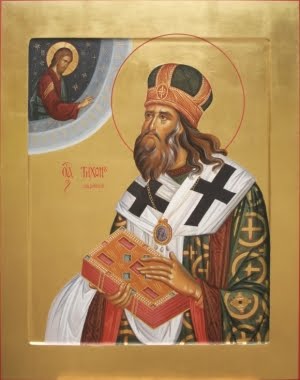
By Saint Tikhon of Zadonsk

Since You came into the world for all, O Savior, therefore You came for me, for I am one of all. You came into the world to save sinners; therefore You came to save me also, for I am one of the sinners. You came to find and to save him who was lost; therefore You came to seek me too, for I am one of the lost.

O Lord, O my God and Creator! I should have come to You as a transgressor of Your law. I should have fallen at Your feet, cast myself down before You, humbly begging forgiveness, pleading with You and craving Your mercy. But You Yourself have come to me, wretched and good-for-nothing servant that I am; my Lord has come to me, His enemy and apostate; my Master has come and has bestowed His love of mankind upon me.

Listen, my soul: God has come to us; Our Lord has visited us. For my sake He was born of the Virgin Mary, He Who is born of the Father before all time. For my sake He was wrapped in swaddling clothes, He Who covers heaven with the clouds and vests Himself with robes of light. For my sake He was placed in the lowly manger, He Whose throne is the heavens and Whose feet rest upon earth. For my sake He was fed with His mother's milk, He Who feeds all creatures. For my sake He was held in His mother's arms, He Who is borne by the Cherubim and holds all creatures in His embrace. For my sake He was circumcised according to the law, He Who is maker of the Law. For my sake, He Who is unseen became visible and lived among men, He Who is my God.

My God became one like me, like a man; the Word became flesh, and my Lord, the Lord of Glory, took for my sake the form of a servant and lived upon earth and walked upon earth, He Who is the King of Heaven. He labored, worked miracles, conversed with men, was like a servant, He Who is the Lord of all. He was hungry and thirsty, He Who provides food and drink for all creatures. He wept, He Who wipes away all tears. He suffered and mourned, He Who is the consoler of all men. He consorted with sinners, He Who alone is just and holy. He Who is omnipotent toiled and had nowhere to lay His head, He Who lives in light inaccessible. He was poor, He Who gives riches to all men. He wandered from town to town and from place to place, He Who is omnipresent and fills all space. And thus for thirty-three years and more He lived and labored upon earth for my sake—I who am His servant.

O Son of God Who ceased not to dwell in His Father's bosom! What did You behold in me of merit? Why did You come to seek me in this vale of tears? Shepherds search for their lost sheep, but for their own profit. Men seek their lost property, but out of self-interest. Travelers visit foreign countries, but for their own benefit. Kings offer the ransoms of prisoners, but they pay it in gold and silver through their ambassadors, and largely for their own gain. But You, what was it that You found in me, my Lord? What use, what interest, what good did You behold in me that You came to seek me? And it was the King of Heaven and Earth Himself who came, not His ambassadors. God himself came to find and to ransom His servant, not with gold and silver but with His precious blood. Nothing indeed did you find but corruption, weakness, misery, disobedience and enmity towards Yourself. It would have been a deed sufficiently great, had You come to seek me because I had been lost through no will of my own, wrested from You by force and imprisoned by the enemy. But the marvel is that I, of my own will, am an apostate and Your enemy. I am ashamed to admit as much, but it is the truth: I am an apostate; I have followed in the path of Your enemy. I entered this conspiracy desiring to snatch Your divine honor. I, Your creature, not content that You have dignified me above the rest of Your creation by bestowing on me a rational soul and making me in Your own image, have desired to become God! This great dignity has seemed too mean to me, and I have wanted to become God, to dishonor You Who have honored me, my Lord! I have provoked You exceedingly and insulted Your immeasurable greatness, and in this manner have I become Your enemy.

Thus I stand before You, I for whose sake You came to earth. Beholding in me nothing but my need of salvation, You have come to seek me. For You so looked upon me that my misfortune and my perdition became Your loss, my salvation Your gain. That I should be saved and should attain eternal happiness, this You considered to be Your gain. For Your generosity could not bear to see me in perdition; it impelled You, Invisible One, to descend and to seek me. Not a mediator, not an angel, but You Yourself, my Lord, came to me. You came to me, for I could not come to You. The Shepherd had to come and to labor in order to find the sheep lost in the hills. You showered upon me Your loving-kindness, my Lord. You sought me disinterestedly, my Shepherd.

You loved me without profit, O my God! This indeed is true love: to love without profit, to do good without hope of recompense. Thus did You love me, my Lover: You came disinterested for my salvation. Oh, what kindness and love, Son of God, Son of the Ever-Virgin! Oh, how great is our joy, poor and wretched men for whose sake our Lord and King came to live among us. God likened Himself to men and came to us for our sake.

Blessed is the womb that bore You, and the breasts which gave You suck! Son of God! Blessed are the swaddling clothes in which You were wrapped! Blessed is the crib in which You were laid! Blessed are the arms which sheltered the Infant Who was our God before all time! Blessed are the robes which clothed God Incarnate, Who was arrayed in garments of light! Blessed are the eyes that beheld You and the ears that heard You and the hands that touched You, Living Word and Giver of Life! Blessed is the time in which You, O Heavenly King, came down to earth! Yet, by far more blessed are those who see You, not walking on earth, but sitting at the right hand of the Father—Jesus, in Whom now, not seeing but believing, Your faithful on earth rejoice with an ineffable and glorious joy! Grant that I may see You now with the eyes of faith and honor You through love; that I may look upon You then face to face!

But look, O my soul, and see how the King of Heaven was welcomed by His subjects, in what manner they honored their God Incarnate: what offerings, what thanksgivings, what honors they bestowed on their Benefactor, Who had come to save them, Who performed miracles before them—Who cleansed the lepers, healed the sick, made the paralytic walk and the blind man see; Who straightened the lame and the crippled, Who raised the dead and fed the many thousands who were hungry.

Oh, shame covers my face, awe grips my heart, and my tongue trembles to speak! His holy Evangelist cries out in grief: “He came to His own, and His own received Him not.” And they repudiated him, saying: "We do not wish this man to rule over us." Terrible and piteous are these words! God in flesh came to His people, and they did not receive Him. The King and Lord came to His servants, and they rejected Him. Listen, O heaven, and hearken, O earth! Men did not accept their God; servants did not receive their Lord; subjects rejected their King! O, my God, all this You knew, and yet You came to save me, perishing; to find me, the lost! You were not turned away by the wickedness and the ingratitude of Your enemies; You surrendered Yourself to Your love and kindness; You were persuaded by my wretchedness.
It was not enough that ungrateful men should reject their Lord and Benefactor. They piled wickedness upon wickedness, cruelty upon hardness. They considered Your divine teaching to be inspired by the devil: “He has a devil, and is mad: why do you hear Him?” They attributed Your miracles to Beelzebub: “This man casts not out demons but by Beelzebub the prince of demons.” Because you mingled with sinners, desiring to win their souls by Your compassion and to save them, they called You a glutton and a drunkard, the friend of publicans and sinners, and they vomited forth all manner of blasphemies against You, their Lord and Benefactor, against You Who are beyond all glory! Oh, the cruelty and ingratitude of men! Oh, the patience and magnanimity that You showed, my Lord! And more—they sought to kill You, their Savior. You beheld their wicked plans, their hearts instinct with hatred. You looked into them, Reader of hearts; yet You suffered in silence. They found an instrument for their designs, Your ungrateful disciple. And he sold them Him Who is without price for thirty pieces of silver. He sold for this paltry sum Him Who is more precious than the whole world, than a thousand worlds! You witnessed this evil design, this iniquitous bargain; and You permitted it, desiring to suffer for my sake, Your unworthy servant, to cleanse me with Your blood, to give me new life by Your death, to honor me through Your disgrace. Glory be to You for all, O my Lover!

You were betrayed and sold; or, to speak more truly, You gave Yourself up to them and freely went to them, knowing all that would follow. And they bound You, the Lord inaccessible to the Seraphim and the Cherubim! They judged You, the Judge of the living and the dead! They insulted and dishonored You, spat upon Your holy face, to which angels dare not lift their gaze! And they buffeted Your check and condemned You to death—You, the Life of all! They preferred a robber and a murderer to You, the Son of God, the only good and just One! The people cried with one voice: “Away with this man, and release unto us Barabbas. Crucify him, crucify him.” Oh prodigy! Oh, fearful and unheard-of crime! They led Him out of the city like a condemned criminal, and they hung Him like a villain, between two villains. They put to death the Immortal One, and as He hung on the cross they mocked Him and wagged their heads. They fed Your hunger with gall and quenched Your thirst with vinegar. They pierced Your hands and Your feet and numbered all Your bones. And when You expired, they pierced Your side. And then once more they mocked You in death: “We have remembered, that that seducer said, while he was yet alive: After three days I will rise again.” They placed a guard over Your most pure body and scaled Your tomb. This is what Your people did to You, my Lord; to You Who came to save them!

You suffered their fury, and like a lamb led to the slaughter, You did not open Your lips. The Lord suffered at the hands of His servants, the Creator at the hands of His creatures, the King at the hands of His subjects, the Benefactor at the hands of those who received from Him innumerable gifts, the Just and Innocent at the hands of the lawless. He suffered before Heaven and earth, in the sight of angels and men, before a great multitude of spectators, in the sight of friends and enemies. He suffered, naked and abandoned by all. And because He came into the world for the sake of all, He therefore suffered for me too, for I am one of all, O my Lord!

For my sake did he bear so great a humiliation, O my Lord! And who am I, and what am I? Ashes and clay, a sinner and a worthless slave! Oh, new and unheard of miracle! Oh, unutterable and ineffable mercy! Incomprehensible indulgence! Arise, my soul, arise! Be filled with awe; humble yourself, bow low and fall at the feet of your Lord! “Sing ye to the Lord a new canticle; because He hath done wonderful things.”

My Lord and Creator suffered, endured His passion, and died for His worthless servant and lawbreaker. I who broke the law, I the traitor; I who utter insults and blasphemies; I who have given myself up to my enemy, the Devil. I deserve to be spat upon by the Devil; I deserve to be mocked, insulted, buffeted, beaten, tortured, to die for all eternity! But You, my Lord and Sovereign, have suffered in my place. The servant sinned, but my Lord suffered the punishment; the servant erred, but my Lord was scourged; the servant stole, and my Lord offered compensation; the servant was indebted, but my Sovereign paid the debt. And in what manner did He pay it? Not in gold and silver but with His disgrace, His wounds, His blood, His death on the cross.

For me, wretched and accursed, He bore the infamy, He Who is blessed throughout all eternity. For my blasphemies and my insults, He suffered disgrace, He Who is the Lord of Glory. For me—I who was held captive for sin—He was sold, He Who is beyond price. For me He stood trial and was condemned. For me He suffered death, my Lord and Creator!

Glory be to You, glory be to You, glory be to You for all things! I have nothing else to bring to You but this: glory be to You! You lived on earth, King of Heaven, to lead me to heaven—I who had been cast out of paradise. You were born in the flesh of the Virgin to give me birth in the spirit. You suffered insults to silence the mouths of my enemies who calumniated me. You abased Yourself, You Who are higher than all honors, in order to honor me, the dishonored. You wept to wipe the tears from my eyes. You sighed, grieved, sorrowed to save me from sighing, grieving, suffering pain throughout eternity, to give me eternal joy and gladness. You were sold and betrayed that I might be freed, I who was enslaved. You were bound that my bonds might be broken. You submitted to an unjust trial—You Who are the Judge of all the earth—that I might be freed from eternal judgment. You were made naked in order to clothe me in the robes of salvation, in the garments of gladness. You were crowned with thorns that I might receive the crown of life. You were called king in mockery—You, the King of all!—to open the kingdom of heaven for me. Your head was lashed with a reed that my name should be written in the book of life. You suffered outside the city gates in order to lead me, one who had been cast out of paradise, into the eternal Jerusalem. You were put among evil men—You Who are the only Just One—that I, the unjust, might be justified. You were cursed, the One Blessed, that I, the accursed, should be blessed. You shed Your blood that my sins might be cleansed away. You were given vinegar to drink that I might cat and drink at the feast in Your kingdom. You died—You Who are the life of all—in order to revive me, the dead. You were laid in the tomb that I might rise from the tomb. You were brought to life again that I might believe in my resurrection. You ascended into heaven in order that I too might ascend into heaven and be glorified in Your kingdom. This You have done for me, Your servant, O my Lord!

“What is man that Thou art mindful of him? or the son of man that Thou visitest him?” Man is dust and ashes and the destroyer of Your sacred law. Yet You have honored him, who has dishonored You, Lord and Creator! You have benefited Your creature, my Creator! You have forgiven Your servant, my Master! You have found Your lost sheep, my Shepherd! You have called the one who had been rejected; You have released the one who was in chains, O my Liberator! You have restored to life the one who was dead, O my Life! You have raised the fallen one, O my Strength! You have honored the dishonored one and have defended the defenseless one, O my Intercessor! You have broken the chains that bound me! “I will offer to Thee the sacrifice of thanksgiving.” I offer thanksgiving for Your grace. I kiss Your love of mankind. I adore Your kindness and Your mercy. I pay homage and sing praises to Your ineffable indulgence!

How shall I repay Your generosity, O my Lover? How shall I repay my God for all that He has given me? Had I died a thousand times for Your sake, it would be as nothing. For You are my Lord, my Creator and my God, and I am but clay and ashes, a sinner and a worthless servant, deserving of all manner of deaths, not alone in time but in eternity. How shall I thank You, my Lord, my Lover, my Intercessor, my Liberator, my Redeemer? How shall I reward You, Who did not spare Yourself, but for my sake gave Yourself up to dishonor, insult, mockery, infamy; to be spat: upon, condemned, scourged, wounded, crucified, put to death that I, poor wretch, should be made joyful? How shall I reward You? I who possess nothing that is my own except for my corruption, my impotence, my sin. My soul and body—My nature—is from You—Yours, but alas, corrupted and spoiled by me. The counsel of the Evil One and my own will have corrupted me.

I shall offer You a grateful heart, and that alone You desire of me. But even this thing I cannot do without You. For without You I cannot know You, or having known You, love You. Oh, how poor, how indigent I am! How weak, miserable, corrupt! Oh, how deeply my enemy has wounded, how he has broken me! But O my Liberator, forgive me! For You have loved me and have given Yourself up for me.

Forgive me, and enlighten me, that I may know You in Whom is my life. Kindle the love of You in my heart; set my feet upon the rock; and straighten my steps, so that I may follow You, my Liberator and my only Leader, guiding me to heaven and to eternal life. Draw me after You, O burning Love! Let us run in the path You have trod! I will follow the scent of Your myrrh. For wherever You are, there shall I also be, I, the servant whom You have redeemed, so that I may behold Your glory. O Merciful, O Generous, O Lover of men, give me the heart that is able to follow You; guide me along Your ways, along the path of Your chosen ones; lead me after You by Your Holy Ghost! “Thy Good Spirit shall lead me into the right land.”

You have accomplished a deed so sublime that my mind cannot grasp it! You, the Lord, the King of Heaven and Earth, have come down from Heaven, and have given Yourself flesh of the Virgin Mother of God, and have suffered, have been crucified, have shed Your blood, for me, for the sake of Your servant!

What a sublime, a sublime wonder! I believe and I confess, I acknowledge and I preach, and I marvel that so great a love has been shown me! O Lover of men, my Lover, grant me, a sinner, yet another favor, I humbly implore You: cleanse me of all my sins with Your precious blood, the blood You have shed for the sake of Your sinning servant.

Confirm me in fear of You, and in love of You. Grant that I may follow in Your steps through faith and charity. And guard me by Your strength from my enemies, who seek to stay my feet and to turn me from You, O Redeemer. “And Thy mercy will follow me all the days of my life”; so that, being preserved by Your grace, I shall offer You thanksgiving, face to face, with Your chosen ones, and shall sing, and praise, and glorify You, with the Eternal Father and the Holy Spirit, now and ever, and unto ages of ages. Amen.

Wednesday, November 2, 2011

تربية الأولاد: للقديس يوحنا الذهبي الفم


في الثالث عشر من تشرين الثاني نُعَيِّدُ للقديس يوحنا الذهبي الفم الذي توفي سنة 407. إهتمَّ كثيرا بتربية الأولاد وأسدى نصائح كثيرة للوالدين. إخترنا هنا بضعة مقاطع من مقالة طويلة يبيّن فيها القديس مبادئ التربية المسيحية وغايتها الأساسية.
قال: أتضرَّعُ إليكم متوسِّلا أيها الإخوة الأحباء بأن تجتهدوا بنشاط كُلِّيِّ في تربية أولادكم وأن ترغبوا في خلاص نفوسهم دائما ... يجب أن يحترص الوالدان، أعني الآباء والأمهات، لا ليغنوا أولادَهُم بالفضة والذهب لكن ليصيروا أغنى من ذلك بالورع والتعليم والفضائل وبالأدب أكثَرَ من الكل ولا يحتاجوا الى أشياء كثيرة ... عليكم أنتم أيها الآباء أن تسألوا عن دخولهم وخروجهم وعن كيفية سلوكهم وأن تلاحظوا سعيهم واجتماعاتهم مَعَ مَن هِيَ، لأنكم متى تهاونتم في هذه الأمور كلها، ليس لكم من الله غفران البتة. أنت أيها الانسان تعمَلُ جهدك ليقتني ابنُك بيتًا مزيَّنًا وأملاكًا كثيرةً أو مالاً ومقتنياتٍ شتَّى غير هذه، إسعَ حتى يقتني نية صالحة ونفسًا مهذبة تقيَّةً وأدبًا.
اذا كانت تربية الاولاد من خلال اقتناء عادات صالحة، فصعبٌ عليهم أن يَمِيلُوا الى الشرور متى صاروا بالغين، لأن نفوس الأطفال كالثوب الساطع البياض الذي إذا صُبغَ بلونٍ ما ثبت اللونُ عليه. وأهم هذه العادات الاستماع الى كلام الله والتقوى والفضائل. هذا أهم من أن تتركوا لهم ثروةً ماليةً وأملاكا ... من الضروري أن نهذب نُفُوسَ أولادِنا لأننا إذا ربَّيناهُم على الخير، قاموا هُم بتربية أولادهم هكذا من جيل الى جيل ... إِنَّ الوالدَ لا يَصيرُ أبًا بولادَةِ بَنِيهِ فقط بل بمحبته لهم. فإن كانت الطبيعةُ تقتضي هذه المحبة، فَكَم بالأحرى النعمة.
لا تظنوا أنه يكفيكم أن تُسمَّوا آباءً من غير أن تُرَبُّوا أولادَكُم وتعلِّمُوهم ما هو المفيد لهم نفسًا وجسدًا وما هو الذي يضرُّهم. أنتم تعتقدون أن الغِنى هو الذي ينفعهم مع باقي الأشياء الزائلة. إن كل هذه الأشياء لا تنفعهم بل تضرهم لكونها وقتية زائلة. فما الذي ينفعهم إذًا؟ الحكمة، العلم، الفضيلة، الأدب. أيها الانسان تُرى اذا مرض ابنُك مرضـًا جَسديًّا أفما تبذل كل جهدك وتأتيه بالطبيب ليشفى؟ أما اذا رأيته مَرضَ مَرَضًا رُوحيا أعظَمَ وَأَشَد، فتتماهَل في علاجه؟ فلهذا يجب علينا أن نؤدِّبَ أولادَنَا ونعلِّمَهُم الحكمةَ التي بواسطتها يمكنهم أن يعرفوا جميع الامور ويعرفوا الله أيضا، لأنه بدون المعرفة لا يسهل لأحد أن يعرف الله.
علِّموا أبناءَكُم أن يعرفوا أسرارَ الكنيسة. علِّمُوهُم العَدلَ وَالعِفَّةَ وَالفَهمَ وَشَجاعَةَ النَّفس. أمَا سمعتُم ما قالَهُ الرب في إنجيلِهِ المقدس أنه إذا رَبِحَ الإنسانُ العالَمَ كلَّهُ وَخَسِرَ نَفسَهُ ماذا ينفعه هذا الربحُ وهذه السلطة؟ يجب أن تؤدِّبُوا أولادَكُم فيما تُؤدِّبُونَ ذَواتِكُم لتخلصوا أنتم وهم معا وتنالوا ملكوت السموات بيسوعَ المسيحِ ربِّنَا
.

Friday, October 14, 2011

How TO SCRUTINIZE AND REPROACH YOURSELF


Reflections by St. Ephraim the Syrian:

After having gained knowledge of the truth, I have become a brawler and an offender. I argue over trifles; I have become envious of and callous toward my neighbor, merciless toward beggars, wrathful, argumentative, obstinate, slothful, and irritable. I harbor vile thoughts, I love fancy clothing. And to this day I have many corrupt thoughts and fits of selfishness, gluttony, sensuality, vainglory, arrogance, lust, gossiping, breaking of fasts, despondency, rivalry, and indignation.

I am worthless, but think much of myself. I lie constantly, but get angry with liars. I defile the temple of my body with wanton thoughts, but sternly judge the wanton. I condemn those who fall, but I myself fall constantly. I condemn slanderers and thieves, but am myself both a thief and a slanderer. I walk with a bright countenance, although I am altogether impure.

In churches and at banquets I always want to take the place of honor. I see hermits and act dignified; I see monks and become pompous. I strive to appear pleasing to women, dignified to strangers, intelligent and reasonable to my neighbors, superior to intellectuals. With the righteous I act as if I possess vast wisdom; the unintelligent I disdain as illiterates.

If I am offended, I take revenge. If I am honored, I shun those who dishonor me. If someone demands of me what is rightfully his, I start a lawsuit. And those who tell me the truth I consider enemies. When my error is exposed, I get angry, but I am not so dissatisfied when people flatter me.

I do not want to honor those who are worthy but I myself, who am unworthy, demand honor. I do not want to tire myself with work, but if someone fails to serve me I get angry with him. I do not want to walk among laborers, but if someone fails to help me in my work I slander him.

I arrogantly deny my brother when he is in need, but when I have need of something I turn to him. I hate those who are ill, but when I myself am ill I wish that everyone would love me. I do not want to know those who are higher than I, and I scorn those who are lower.

If I abstain from indulging my foolish desires, I praise myself vaingloriously. If I succeed in vigilance, I fall into the snares of conceit and contradiction. If I refrain from eating, I drown in pride and arrogance. If I am wakeful in prayer, I am vanquished by irritability and wrath. If I see virtue in someone, I studiously ignore him.

I have scorned worldly pleasures, but do not abandon my vain desire for them. If I see a woman, I go into raptures. To all appearances I am wise in humility, but in my soul I am haughty. I seem not to be acquisitive, but in reality I suffer from a mania for possessions. And what good is it to dwell on such things? I appear to have forsaken the world, but in fact I still think about worldly things all the time.

During services I always occupy myself with conversations, wandering thoughts, and vain recollections. During meals I indulge in idle chatter. I yearn for gifts. I participate in the sinful falls of others and engage in ruinous rivalry.

Such is my life! With what vileness do I obstruct my own salvation! And my arrogance, my vainglory does not permit me to think about my sores that I might cure myself. Behold my virtuous feats! See how vast are the regiments of sins which the enemy sends to campaign against me! Yet in the face of all this, I who am wretched endeavor to boast of sanctity. I live in sin, but want others to honor me as a righteous man.

In all this I have but one thing to say in my defense: the devil has ensnared me. But this did not suffice to absolve Adam of his sin. Cain was of course also prompted by the devil, but he did not escape condemnation either. What shall I do if the Lord comes to me? I have no means to justify my negligence.

I fear that I shall be numbered among those whom Paul called vessels of wrath, who will share the devil's fate and whom God, because of their contempt for Him, has committed to the passions of degradation. Thus there is the danger that I will be sentenced to the same fate.

If Thou wouldst save me, who am unworthy, O Merciful Lord, vouchsafe me, a sinner, repentance. Enliven my soul deadened by sins, O Giver of Life. Drive out the stony hardness that is in my miserable heart, and grant me a fountain of contrition, O Thou Who didst pour forth life unto us from Thy life creating rib.

Source: The Eighth Kathisma/The First Stasis, 55: A Spiritual Psalter or Reflections on God. Excerpted by Bishop Theophan the Recluse. From the Works of our Holy Father Ephraim the Syrian. Arranged in the Manner of the Psalms of David. Translated by Antonina Janda. The St. John of Kronstadt Press.

Saturday, August 6, 2011

The Feast of the Transfiguration of Christ: The Summer Feast of the Lord

The Transfiguration of Christ is recorded in the three synoptic gospels. Saints Matthew, Mark, and Luke comprise the synoptic gospels, whereas the Gospel according to Saint John is exclusively “theological.” Saint John, on purpose as it may seem, avoids recording the Transfiguration because according to his gospel account, Jesus is already transfigured, from the beginning of the gospel (“In the Beginning was the Word, and the Word was with God, and God was the Word…”).

Immediately after the Lord was recognized by His Disciples – through Peter’s confession – as “the Christ [i.e. Messiah], the Son of the Living God,” He told them that He “must go up to Jerusalem and suffer many things … and be killed, and on the third day be raised.” In the Transfiguration, the Disciples see the glory of the Kingdom of God present, in Majesty, in the Person of Christ. They see that in Christ, indeed, “all the fullness of the Father was pleased to dwell,” that “in Him the whole fullness of the Godhead dwells bodily” (Colossians 1:19, 2:9). They see this before the Crucifixion, so that during and after the Resurrection, they might know Him who suffered for them. This is what the Church celebrates in the feast of the Transfiguration.

Besides the fundamental meaning which the Transfiguration has in the context of the life and mission of Christ, and in addition to the theme of the glory of God which is revealed in all of its divine splendor of the Savior, the presence of Moses and Elias is also of great significance for the understanding and celebration of the feast: Moses and Elias, according to the liturgical hymns, are not only the greatest figures of the Old Testament who now come to worship the Son of God in glory, but they actually stand for the entire Old Testament itself: Moses for the Law and Elias for the Prophets. And Christ is the fulfillment of the Law and the Prophets (Matthew 5:17). The two also stand for the Living and Dead, for Moses died and his burial place is known (Mount Nebo in modern-day Jordan), while Elias was taken alive into heaven in order to appear again to announce the time of God's salvation in Christ the Messiah: “Behold, I will send you Elias before the coming of the Great and Glorious Day of the Lord” Malachi 3:22.

None of the gospels mentions the Transfiguration Mount by name! Church Tradition holds that it was Mount Tabor, or probably Harmon as well, as per the liturgical hymns of the Feast! By appearing with Jesus on the Transfiguration Mount, Moses and Elias show that the Messiah Savior is present, here and now, and that He is the Son of God to whom the Father Himself bears witness, the Lord of all creation, the Lord of the Old and New Testaments, and, the Lord of the Living and of the Dead. The Transfiguration of Christ in itself is the fulfillment of all of the appearances/manifestations of God, a fulfillment made perfect and complete in the Person of Christ Jesus. The Transfiguration of Christ reveals to us our ultimate destiny as Christians, the ultimate destiny of all men and all creation, namely, to be transformed and glorified by the majestic splendor of God Himself.

The Feast of the Transfiguration is celebrated on August 6TH as the summer celebration Feast of the Lord (in the Northern Hemisphere, since the Holy Land lies in that territory of Earth, where the Summer Season is June 21ST through September 21ST). No one knows for sure when the Transfiguration took place! According to the gospel accounts, and their context, the Transfiguration took place in order to inaugurate the Passion of the Christ: Its foretelling and its occurrence. Thus, being linked to the Passion and to the Cross, the Church Fathers appointed the Celebration of this Feast on August 6TH, FORTY DAYS before the Great and Universal Feast of the Holy Cross September 14TH. Thus, the themes of the Transfiguration and the Cross are connected.

The Blessing of Red Grapes, being the first-fruits of the harvest, is the most beautiful and adequate sign of the final transfiguration of all things in Christ – Red Grapes do not start out as red, but as white, and as they ripen, they turn red, in essence, they “transfigure” in color. It signifies the ultimate flowering and fruitfulness of all creation in the paradise of God's unending Kingdom of Life where ultimately all things will be transformed by the glory of the Lord.


Troparion of the Feast of the Transfiguration (Tone 7)
When, O Christ God, Thou wast transfigured on the mountain, Thou didst reveal Thy glory to Thy Disciples in proportion as they could bear it.  Let Thine everlasting Light also enlighten us sinners, through the intercessions of the Theotokos, O Thou Bestower of Light, glory to Thee.

Kontakion of the Feast of the Transfiguration (Tone 7)
Thou wast transfigured on the mountain, and Thy Disciples, in so far as they were able, beheld Thy glory, O Christ God; so that, when they should see Thee crucified, they would remember that Thy sufferings were voluntary, and could declare to all the world that Thou art truly the effulgent Splendor of the Father.

Monday, August 1, 2011

The Significance of Forty Days


I am constantly asked by parishioners and friends, both young and old, of the significance of the 40-Day observation period. The questions that arise are similar to, but not limited to, the following: Why do we have 40 days of preparation for Christmas, the Advent Season for the Nativity of Christ (November 15TH through December 25TH, inclusive)? Why is the Great Fast—not counting Great and Holy Week—approximately 40 Days long? Why do we hold a 40-Day Memorial Service for the rest of the soul of a loved one (in addition to the third-day, ninth-day, annual, and occasional remembrances)?


The core answer to these questions lies in the Sacred Scriptures. The period of Forty Days is biblical in essence, for this is where it comes from, and this is why it is observed. As far as explaining the meaning of it, I prefer to use the following definition: “A period of Forty Days signifies the completion in realization of an event.” I remember back in seminary, over a decade ago, Fr. Thomas Hopko used a similar definition in one of his classes, and I believe this is the most fitting, and for that matter the most genuine Orthodox interpretation. When something, specifically an event, is practiced and remembered for 40 days, it makes it real and present in our daily lives. It becomes sealed in our works and etched in our memory.


I categorically do not like some of the answers or definitions given to the question of 40 Days, claiming the background or sources of these interpretations to be biblical. I am specifically referring to non-traditional Christian groups. Here is one such (false) interpretation as posted on one or more websites:


The number forty has long been universally recognized as an important number, both on account of the frequency of its occurrence, and the uniformity of its association with a period of probation, trial, and chastisement—(not judgment). It is the product of 5 and 8, and points to the action of grace (5), leading to and ending in revival and renewal (8). This is certainly the case where “Forty” relates to a period of evident probation. But where it relates to enlarged dominion, or to renewed or extended rule, then it does so in virtue of its factors 4 and 10, and in harmony with their signification.


Notice the negative terminology in this definition: “Probation, Trial, and Chastisement.” Notice also the perceived positive terminology: “Dominion and Rule.” These adjectives, with all due respect, lack the reality of the lives of the people associated with the 40-Day observances in the Scriptures. They also retract from the positive and real Incarnation: It is as though God is the “extreme other” who never became Incarnate, and never fully identified with and/or shared our humanity.


Sadly, the interpretation(s) of such non-traditional groups, almost always, lacks the appropriate and corresponding Orthodox doctrine of the Incarnation, which is summarized in the teachings of many Church Holy Fathers, starting with Alexandria’s Saint Athanasius the Great[1]: God became Man (by nature) so that man (by grace) may become God. They also retract from an essential teaching of Saint Gregory Nazianzus[2]: What cannot be assumed cannot be saved, meaning that for the entire human nature to be saved, God must assume it in its entirety, except for sin (Hebrews 4:15), which in effect was undertaken and fulfilled by our Lord and Savior Jesus Christ.


The Scriptural references to “Forty” are many, including references to days and years. I shall suffice by citing the important ones referring specifically to “Forty Days.” Let us examine these, closely and contextually:
·         (Genesis 7:4, 17) The Great Flood: “For after seven more days I will cause it to rain on the earth forty days and forty nights, and I will blot out from the face of the earth every living thing I made” and, “Now the flood was on the earth forty days and forty nights. The waters increased and lifted up the ark, and it rose high above the earth.” Our humble definition, once again, states: “A period of Forty Days signifies the completion in realization of an event.” In order for the Flood to be “Great”, encompassing the known world at that point, its duration needed to be long enough so that all concerned parties would realize its effectiveness as a real event. The rain, falling for a period of forty days, would signify the completion, in realization, of the universal flood, thus rendering the Great Flood. In essence, the Great Flood was by all means real, because it lasted for forty days and forty nights.
·         (Exodus 24:18 & Deuteronomy 9:18, 25) The Fasting and Praying of Moses the Great: “So Moses went into the midst of the cloud and went up the mountain; and he was on the mountain forty days and forty nights”; “And I prayed before the Lord a second time, as at the first, forty days and forty nights; I neither ate bread nor drank water, because of all your sins you committed in doing wickedly in the sight of the Lord your God to provoke Him”; and, “Thus I prayed before the Lord; forty days and forty nights I kept praying, because the Lord said He would destroy you.” The Fasting and Praying of Moses the Great, along with that of the Lord Jesus Christ, together, constitute the solid and official Orthodox Christian standpoint, from the Sacred Scriptures, concerning the rule of Fasting. Moses fasted before receiving the Law on Mount Sinai. The period of Forty Days and Forty Nights made the Fasting of Moses complete and real; it concretized its reality. Thus, the Fasting and Praying of Moses the Great was by all means real, because it lasted for forty days and forty nights.
·         (Ezekiel 4:6) The Binding of Ezekiel/Judah: “When you accomplish all this, then you shall sleep on your right side; and you shall bear the acts of unrighteousness of the house of Judah for forty days. I have appointed you a day for each year.” Ezekiel lying bound on his side images the death of Christ, the Lamb of God, who bore the acts of unrighteousness for all humanity[3]. Ezekiel stands out among the Prophets, in that, more than any other Prophet, he was called by God to involve himself personally in the divine word by acting it out in prophetic symbolism.  The actions of the Prophet concretized the reality of the house of Judah, equating the number of days of the Prophet’s lying bound with the number of years of unrighteousness concerning the house of Judah. Thus, the Binding of the Prophet Ezekiel made real the Binding of the House of Judah, because it lasted for forty days.
·         (Matthew 4:1-2) The Fasting and Praying of the Lord Jesus Christ: “Then Jesus (after His Baptism) was led up by the Spirit into the wilderness to be tempted by the devil. And when He had fasted forty days and forty nights, afterward He was hungry.” The Fasting and Praying of the Lord Jesus Christ was real, simply because it lasted for forty days and forty nights.
·         (Acts 1:1-3) The Resurrection of the Lord Jesus Christ: “IN THE FIRST WORDS, O Theóphilos, I have dealt with all that Jesus began to do and teach, until the day when He was taken up, after He had given commandment through the Holy Spirit to the apostles whom He had chosen.  To them He presented Himself alive after His passion by many proofs, having been seen by them for forty days, and speaking of the Kingdom of God[4].” In the Orthodox Church, for forty days – from the Great Feast of Pascha to its leave-taking on Wednesday before the Ascension, all days inclusive – we chant and greet one another with the phrase: “Christ is Risen!” Thus, as the Holy Evangelist states, the Resurrection of the Lord Jesus Christ was real, because it lasted for forty days.
We can see similar conclusions in these Scriptural references, conclusions which further validate the definition: A period of Forty Days signifies the completion in realization of an event:
·         The Season of Advent (November 15TH through December 25TH, inclusive) is observed for forty days, typically, in order to make real the daily presence of Christ in our lives.
·         The Forty Day Memorial services which we hold for rest of the souls of our loved ones seal the reality in our minds and conscience that that person is no longer physically with us. The mourning season (should) cease and the healing process now begins.
There are many other seasons in the Church which are either liturgical or personal which take the shape of forty days. These are set by the Church Holy Fathers, in their wisdom – from the Same Spirit who inspired the Earlier Fathers/Writers of the Sacred Scriptures – to train us in the Spiritual Life. It is simply the process which we call the Sanctification of Time. The Sanctification of Time, when conscientiously practiced, makes real in our daily lives the elements which we celebrate or commemorate. Thus, we can relate better to the Sacred Scriptures and to the Liturgical Life of our Faith.


[1] On St. Athanasius’ quote, I have simplified his quote it in line with the Orthodox teaching. The actual quote reads: "God became man so that man might become a god" (St. Athanasius the Great, On the Incarnation 54:3, PG 25:192B)
[2] On St. Gregory Nazianzus, I have also simplified the quotation, which in full reads: “For that which He has not assumed, He has not healed; but that which is united to His Godhead is also saved” - Gregory Nazianzus, Epistle 101 (PG XXXVII 181C-184A)
[3] These remarks are copied from a Footnote and the Introduction in the Orthodox Study Bible, pages 1188 & 1184, respectively
[4] The above quote (Acts 1:1-3) is taken from The Book of the Epistles, © 2010 Self-Ruled Antiochian Orthodox Christian Archdiocese of All North America

Saturday, July 30, 2011

مَوعِدُكَ فِي القُدَّاس


القداس موعدٌ لك مع الرب! في الحياة الإجتماعية لا يذهب أحد الى موعد متأخِّرًا. يُعتَبَرُ هذا أنك لست جدِّيًّا بالتعامل مع من ٱرتبطت معه بموعد أو أنك غير مشتاق اليه، وتجعله ينتظر ويتحسَّر على أوقات أضاعها بانتظار. لماذا عند بدء الصلاة في أحد أو عيد لا نجد غير ثلاثة من الناس أكثرهم من النساء المسنَّات؟ ألا يعني هذا أن هذه الكلمات التي يتلوها الكاهن أو يرتِّلُها المرتل لا تهمّ الذين تغيّبوا لِعِلَلٍ غَيرِ ممدوحة؟ كانوا في بيوتهم يحتسون القهوة أو يتناولون فُطورًا أو يستمعون الى الأخبار. ناموا قبل ليلة وٱستيقظوا كما في بقية اليوم. هل يقولون في أنفسهم: القداس جارٍ "فينا وبلانا"؟ نأخذ نصيبنا منه بعد تباطؤ. هؤلاء لا يعلمون أن المسيح ينتظرهم في كنيسته وأن الكلمات التي رُتِّب بها القداس إنما رتَّبها الأقدمون محبةً للناس الحاليين حتى ينمُوا بمحبة الله ويَصِلُوا الى أعماق المسيحية. لماذا لا يعلمون أن السيّد يُحبُّ الذين حضروا منذ البدء والذين تأخَّروا على ألا يتأخروا. هو يغفر لهم ضعف همّتهم وقلّة حماستهم حتى يكسبوا الحماسة ويتجدَّدُوا بالمعرفة ولا يُفوِّتُوا عليهم كلمة نافعة.
مرة دخلتُ كنيسةً في صلاة الغروب في الوقت المحدَّد، ولاحظتُ أن الصلاة ٱبتُدِئَ بها قبل موعدها بدقيقتين أو ثلاث. هذه يُقرَأُ فيها مزمور الغروب. قلتُ للكاهن في نهاية الخدمة: ضيَّعتَ على الذين يجيئون في الوقت المحدد عدَّة آيات من المزمور كان يمكن أن تساعدهم على الخلاص. ربما كانت توبتهم متعلّقة ببعض كلمات لم يسمعوها. هو الشوق ناقص عند بعض منّا. أنت إن أحببتَ المسيح تُفتّش عن ظهوره، وظهورُه في القداس الإلهي عظيم. هو القائل: "الكلام الذي أُكلّمكم به نور وحياة". ألا تريد النور؟ ألست تريد الحياة؟ أنت لا تُفَبرِكُ دينًا لنفسك. أنتَ تأخذ الدين الذي ورثته من آبائك وأجدادك. والدِّينُ المسيحيُّ الذي أنت عليه قلبُه الصلاة وقلبُ الصلاة القداس.
وأَرجو ان تكون عالمًا بأن القداس هيكليَّة كاملة فلا تأخذ جزءًا وتترك جزءًا. إيضاحًا لذلك أقول: كيف تستطيع أن تصل بعد الإنجيل؟ ألا تكون قد حاولت أن تُقنِعَ نَفسَك بأن ما قُرِئَ على المؤمنين لك أنت أن تستغني عنه. والرسالة، مَن قال إنها لا تنفع بنيانك الروحيّ والإنشاد الذي قبلهما؟ كيف تتناول جسد الرب ولا تتناول الإنجيل؟ كل هذا يُعطيك الرب إياه. كل هذا لخلاصك، وبالنتيجة لخلاص أهل بيتك. هؤلاء يُريدونك قويا في الإيمان ونافعًا لهم بالإيمان.
أنت تُحبّهم بما فيك، بما ٱكتسبته من كنيسة الرب. هل أنت تترك لزوجتك أن تعطي أولادك المسيحية ولا تُسهِمُ أنت بإعطاء المسيحية؟ لا تتَّكل على التعليم الدينيّ في المدرسة. بأهمية التعليم أو أهم من التعليم أن تكون المسيحية فيك، في كلامك، في عينيك. تعال لنكون كل أحد معًا، لكي لا تبقى غريبًا عنَّا نحن المصلِّين. نحن وإياك جسد المسيح. لا تُفرِّقنا بغيابك عنا. في الكنيسة نصبح واحدًا. تعال!
+ جاورجيوس مطران جبيل والبترون وما يليهما للروم الأرثوذكس – جبل لبنان